News industry-news
Operation Serengeti III: INTERPOL arrests 1,462 and disrupts 10,909 cybercrime networks across Africa
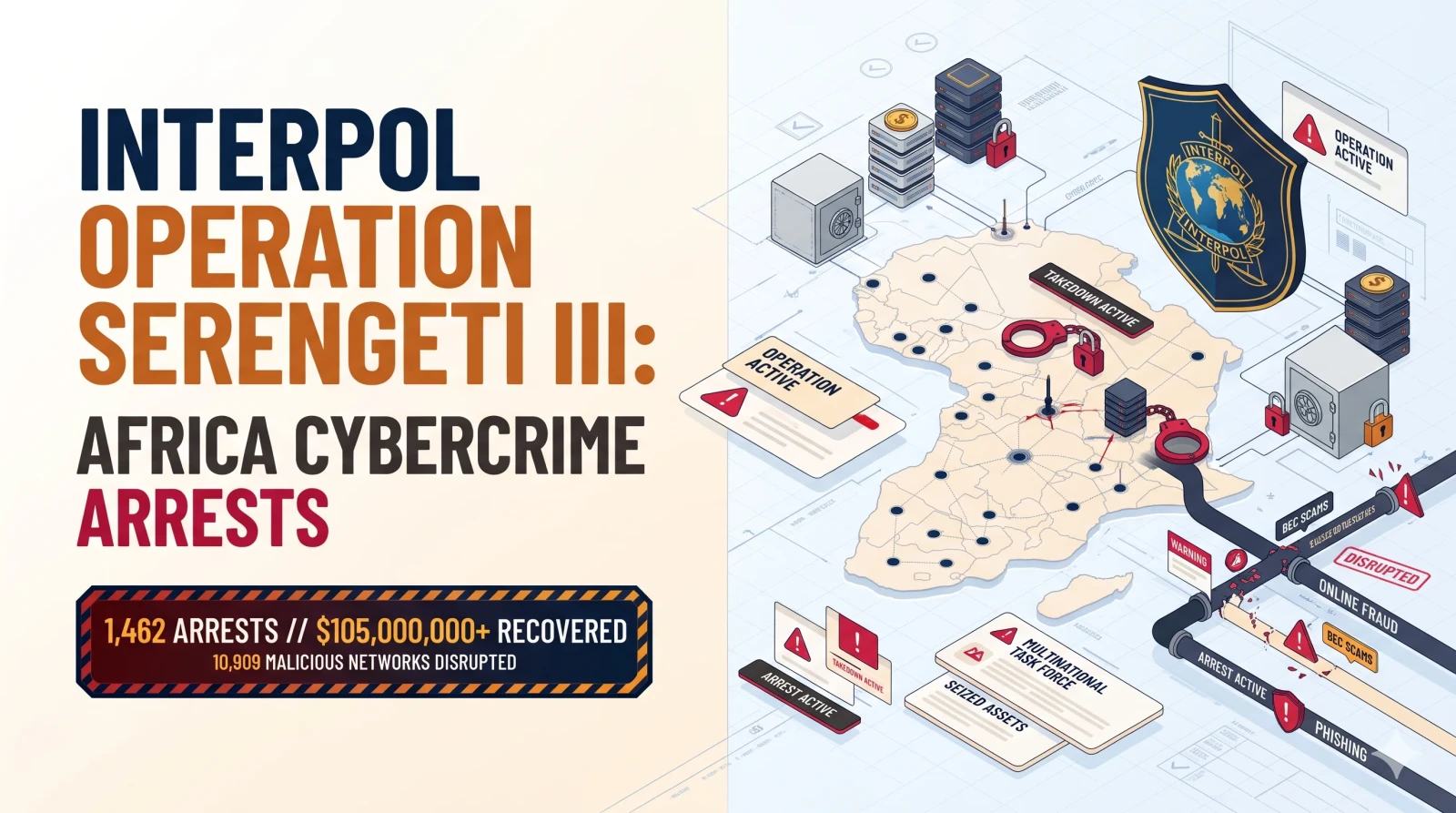
INTERPOL says Operation Serengeti III, run across 21 countries from June to August 2026, led to 1,462 arrests, the disruption of 10,909 malicious networks and the recovery of more than USD 105 million linked to scams and cybercrime.
Key takeaways
- INTERPOL's Operation Serengeti III led to 1,462 arrests across 21 countries.
- It disrupted 10,909 malicious networks and recovered more than USD 105 million.
- Nearly 66,000 victims were identified, with losses above USD 385 million.
- Cases included investment scams, phishing, illegal crypto mining and malicious loan apps.
- Private sector partners supplied intelligence on domains, IP addresses and servers.
INTERPOL announced on 22 October 2026 that a two-month crackdown on cybercrime in Africa, Operation Serengeti III, led to 1,462 arrests and the recovery of more than USD 105 million.
What did the operation achieve? #
| Measure | Result |
|---|---|
| Period | 29 June to 31 August 2026 |
| Countries taking part | 21, including the United States |
| Arrests | 1,462 |
| Malicious networks disrupted | 10,909 |
| Funds recovered | More than USD 105 million |
| Victims identified | 65,929 |
| Losses linked to the crimes | More than USD 385 million |
INTERPOL's Director of Cybercrime, Neal Jetton, said: "Cybercrime networks operate without regard for borders."
What kinds of crime were targeted? #
INTERPOL highlighted several cases:
- Uganda: two transnational fraud rings dismantled and 365 foreign nationals arrested over investment and pension scams targeting victims in Asia.
- Angola: two illegal cryptocurrency mining sites shut down, nine arrests and more than 2,000 mining devices seized, along with six power transformation stations worth over USD 1 million.
- Nigeria: one suspect arrested over a phishing operation that gathered about 2.1 million email addresses, and another over an investment fraud scheme that moved more than USD 2.4 million, much of it laundered through cryptocurrency.
- Tanzania, Gabon and the Republic of Congo: a malicious mobile loan app scheme dismantled, a social media vehicle import fraud network disrupted and 30 suspects arrested.
Who helped? #
Private sector partners included Group-IB, Kaspersky, Fortinet, TrendAI, Team Cymru, Uppsala Security, Cybercrime Atlas, Meta and the Global Anti-Scam Alliance. The operation was co-funded by the GLACY-e project of the European Union and the Council of Europe. INTERPOL says several investigations remain open, The Record reported.
What can businesses and individuals learn? #
- Be wary of investment and trading offers promoted through messaging apps and social media.
- Treat loan apps that demand broad phone permissions or upfront fees as suspicious.
- Protect email accounts with multi-factor authentication, since phishing and business email compromise remain central to these schemes.
- Report fraud quickly to local police or national cybercrime reporting channels, which can help trace and recover funds.
Sources
Questions this raises
- When did Operation Serengeti III run?
- From 29 June to 31 August 2026, according to INTERPOL.
- How much money was recovered?
- More than USD 105 million, INTERPOL says.
- Which countries took part?
- Law enforcement from 21 countries, including African nations and the United States.
Law EnforcementCybercrimePhishingFinancial CybersecurityINTERPOLAfrica