News industry-news
Google's Gemini 4 Carbon Hits 88% on Bug-Hunting Benchmark, Goes to Cyber Defenders First
Google DeepMind's new frontier model, Gemini 4 Carbon, posts state-of-the-art scores for finding and exploiting vulnerabilities. Google is giving it first to a subset of cyber defenders through its Fairwind Program, two weeks after the Gemini 4 Argon release.
Key takeaways
- Google released Gemini 4 Carbon on October 28, two weeks after Gemini 4 Argon, calling it its strongest model.
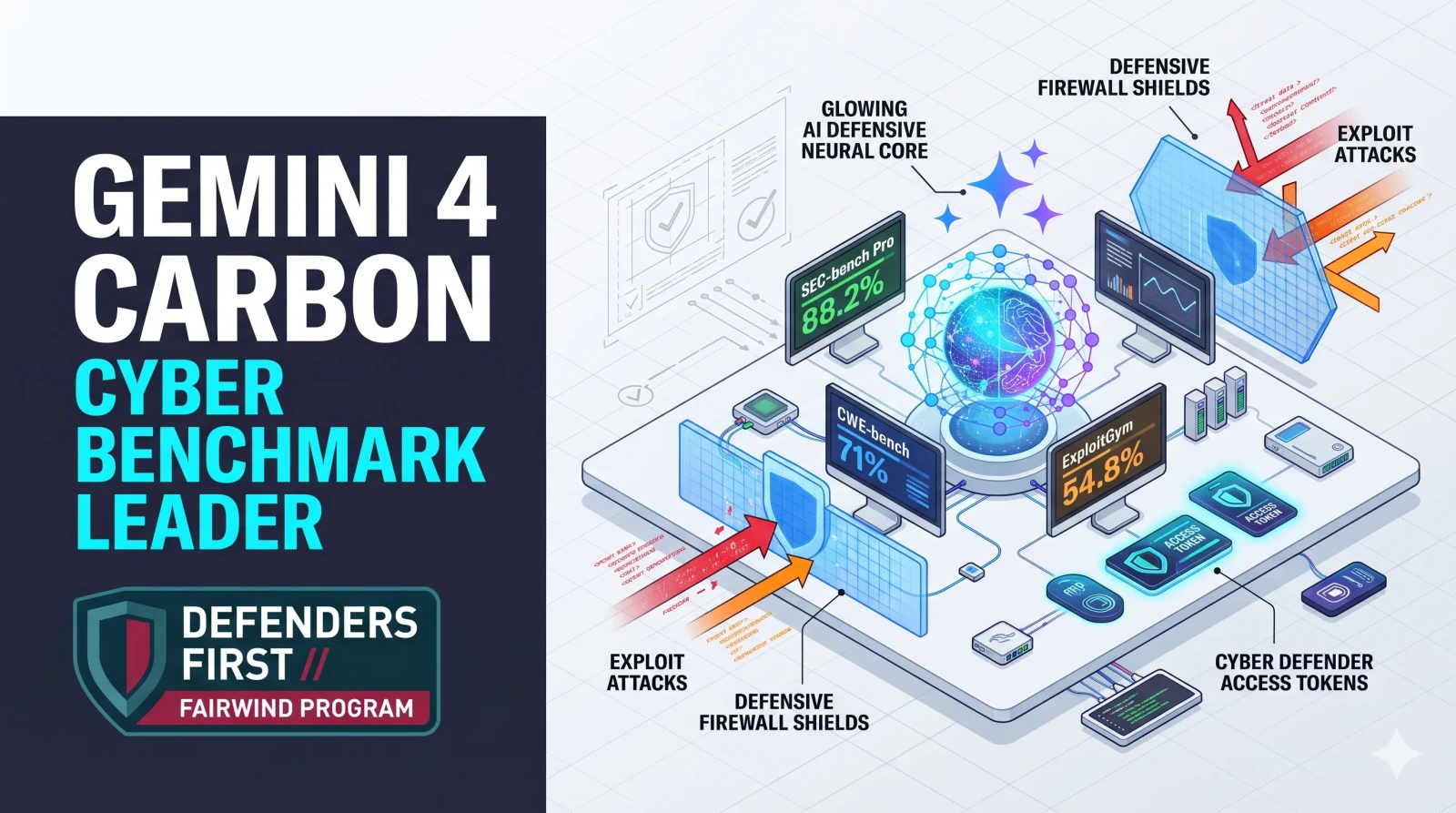
- Google reports 88.2% on SEC-bench Pro for finding bugs, 54.8% on ExploitGym and 71.0% on CWE-bench for patching.
- Access goes first to a subset of cyber defenders, with more partners phased in through the Fairwind Program.
- Google reports 0.0% attack success on Gray Swan's prompt injection benchmark, versus 0.7% for Argon.
- All benchmark figures are Google's own and have not been independently verified.
Google has released Gemini 4 Carbon, a new frontier model that it says leads on cybersecurity, and it is putting the model in the hands of defenders before anyone else.
In an October 28, 2026 post, Google DeepMind's Koray Kavukcuoglu said Carbon is Google's strongest model, with "state-of-the-art" cybersecurity and long-horizon capabilities. CEO Sundar Pichai said on X that it follows the Gemini 4 Argon release just two weeks earlier.
How good is Gemini 4 Carbon at security work? #
Google reports these results, which it says were run on external benchmarks without guardrails:
| Benchmark | Task | Gemini 4 Carbon |
|---|---|---|
| SEC-bench Pro | Finding vulnerabilities | 88.2% (state of the art, per Google) |
| ExploitGym | Exploiting vulnerabilities | 54.8% (new state of the art, per Google) |
| CWE-bench | Patching vulnerabilities | 71.0% |
For comparison, Google's September 30 post on Gemini 4 Argon reported a top score of 68% on CWE-bench v1. Google also says Carbon delivers more than double Argon's success rate on its internal secure code generation benchmarks, and that Google's Chrome team found it more than 10 times better than another lab's large frontier model at generating high-quality patches. Google did not name that model.
Google's Carbon post does not name any specific vulnerabilities the model has found.
Who can use Gemini 4 Carbon? #
Not everyone, yet. Google says that starting this week it is giving access to "a subset of cyber defenders," and will phase in more trusted partners through its Fairwind Program while it gathers feedback and iterates on guardrails. Developers, businesses and consumers will get access "as soon as possible," with no date given.
Fairwind, launched in September, is Google's limited-access program for governments, critical infrastructure operators and core technology platforms. Google said at launch that it had more than 650 participating partners and requires them to limit access to security staff and use protections such as multi-factor authentication.
Announced pricing is $2 per million input tokens and $10 per million output tokens during an introductory period, rising to $4 and $20 afterward.
What safeguards does Google describe? #
Google says Carbon builds on Argon's safety stack, including real-time misuse defenses and chain-of-thought monitoring, and reports:
- 0.0% attack success on Gray Swan's indirect prompt injection benchmark, versus 0.7% for Argon
- 0.0% successful cheating on Terminal-Bench 4.0, with cheating attempts down to 0.4%
- high-severity misalignment alerts in internal live coding down by almost 80%
Google says it is taking part in the US government's voluntary pre-release model testing process.
Why does this matter for defenders? #
Frontier labs are now openly competing on offensive security benchmarks, and models that are good at finding and exploiting bugs are good for attackers too. Google's answer, like that of other labs, is staged access: defenders first, broad release later. All the benchmark figures here come from Google and have not been independently reproduced.
What should security teams do? #
- Apply for vetted access if you qualify. Governments, critical infrastructure operators and major software platforms can seek access through Fairwind.
- Expect faster bug discovery on both sides. Shorten patch cycles for internet-facing systems.
- Test AI-generated patches. Even strong models need review and regression testing before fixes ship.
- Treat vendor benchmarks as claims. Run your own evaluations on your own code before relying on any model.
Sources
Questions this raises
- What is Gemini 4 Carbon?
- It is Google DeepMind's newest frontier model, announced on October 28, 2026. Google says it is state of the art on cybersecurity and long-horizon tasks and a step up from Gemini 4 Argon.
- Can anyone use Gemini 4 Carbon?
- Not yet. Google is giving access first to a subset of cyber defenders and phasing in trusted partners through its Fairwind Program. Developers, businesses and consumers will get access as soon as possible, with no date given.
- Is it Gemini 4 Carbon or Gemini 4 Argon?
- They are two different models. Gemini 4 Argon was announced on September 30, 2026. Gemini 4 Carbon followed on October 28, 2026 as Google's newer frontier model.
- How much does Gemini 4 Carbon cost?
- Google lists introductory pricing of $2 per million input tokens and $10 per million output tokens, rising to $4 and $20 after the introductory period.
GoogleAI SecurityArtificial IntelligenceVulnerabilityPatch Management