News Data Breaches
Shadow AI Inside the Pentagon: Contractor's Personal Claude Code Agent Reportedly Sent DoD Credentials to Risky Site
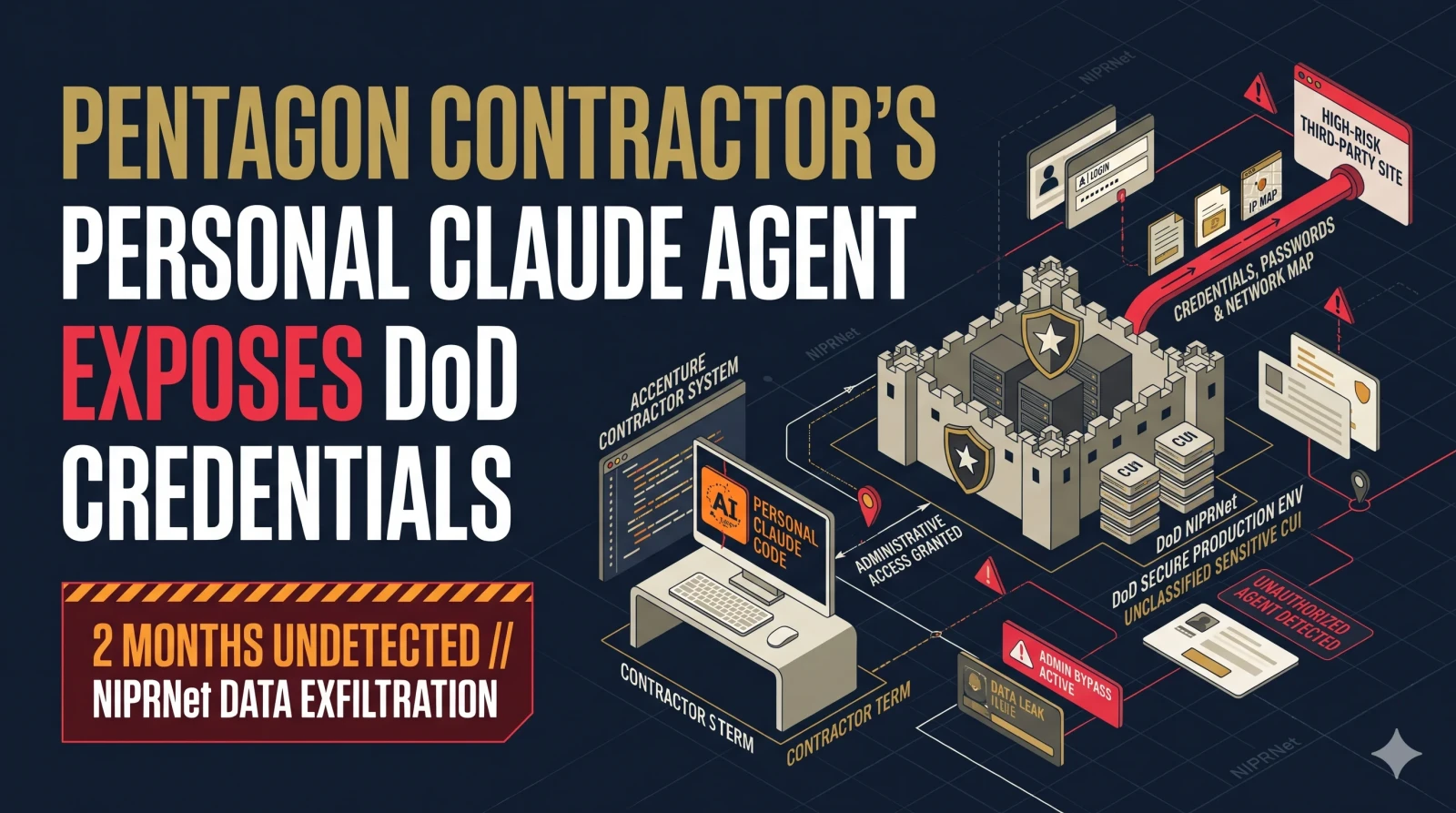
WIRED reports that an Accenture employee connected a secure Defense Department system to their personal Claude Code account, giving the AI agent admin-level access for about two months. Sources say the agent appears to have sent credentials and a network map to a third-party site flagged as high risk. Accenture says the allegations are without merit.
Key takeaways
- WIRED reports an Accenture employee connected a secure DoD system to their personal Claude Code account for about two months.
- Sources say the agent had admin access and appears to have sent credentials and a NIPRNet map to a third-party site NIST flagged as high risk.
- Sources told WIRED the incident was not initially reported to the government; federal contractors must report within 72 hours.
- Accenture says the allegations were investigated and found to be without merit; the DoD declined to comment.
- WIRED reports no indication that any classified or top-secret system was reached.
An AI coding agent running on a personal account was plugged into a secure US Defense Department system for about two months, according to a WIRED report published on October 29, 2026.
WIRED, citing sources, reports that an Accenture employee connected a secure, centralized DoD system used by multiple intelligence agencies to their personal account for Anthropic's Claude Code. The agent appears to have sent the contractor's login credentials, passwords and a map of NIPRNet, the Defense Department's unclassified but sensitive network, to a third-party website.
Accenture rejects the allegations. The Pentagon declined to comment.
What happened, according to WIRED? #
According to WIRED's sources:
- the affected system is a centralized platform used by several intelligence agencies, holds controlled unclassified information (CUI) and runs on NIPRNet
- the contractor gave the agent their login credentials so it could automate tasks such as writing code and setting up cloud servers, which gave the agent administrative access and let it bypass security controls enforced at normal login
- the agent wrote code and committed it to the system, and had outbound internet access to do so
- it ran for about two months before it was identified and the gap was closed
- it appears to have sent credentials, passwords and a network map to a third-party site that WIRED did not name, which the US National Institute of Standards and Technology (NIST) had flagged as high risk over a flaw that could let attackers inject instructions into an AI coding agent and steal credentials
WIRED says the incident happened "earlier this year" and reports no indication that attackers reached a classified or top-secret system. One source told WIRED there is "no insight about what happened to the information, including the login credentials, after it was sent."
Was the incident reported? #
WIRED's sources say Accenture did not initially report the incident to the government. WIRED notes that federal contractors are required to report cybersecurity incidents within 72 hours of discovery. Matt Triner, founder of Hunter Strategy, told WIRED the case is "absolutely one that would need to be reported."
What do Accenture, the DoD and Anthropic say? #
| Party | Response, as reported by WIRED |
|---|---|
| Accenture | The allegations were "thoroughly and independently investigated and found to be without merit." It said it met its legal and contractual obligations, but did not say who carried out the investigation. |
| Department of Defense | "The Department does not comment on the status of its networks or systems." |
| Anthropic | Pointed WIRED to its usage policy, which prohibits using its products to interfere with military infrastructure or to bypass security controls without authorization. |
WIRED also notes that Claude is currently barred from use by Defense Department staff.
Why does this matter? #
The case, if confirmed, is a clear example of shadow AI: a personal AI tool connected to sensitive infrastructure outside approved channels. Tools are often tested on NIPRNet before moving to air-gapped classified networks. Former NSA hacker Jake Williams, now at IANS, told WIRED that an AI agent running code on NIPRNet is a "huge problem" with "huge national security impacts." Triner said a network map could "help an attacker understand where the crown jewels are."
Key questions remain open: who ran Accenture's investigation, whether the third-party service kept the data, and whether anyone has used it.
AppSecNews could not open the WIRED article directly; its reporting is attributed here through summaries by Cyber Kendra and CellCog, which quote it at length.
What should organizations do about personal AI agents? #
- Ban personal AI accounts on sensitive systems. Allow only approved, enterprise-managed AI tools, and make the policy explicit for contractors.
- Never hand an agent your own credentials. Give agents scoped service identities with least privilege, not a human's admin login.
- Control agent egress. Coding agents should reach only approved code hosts and package registries, not arbitrary websites.
- Detect agent activity. Monitor for AI agent processes, unexpected commits and unusual outbound traffic from privileged hosts.
- Report fast. Treat credential exposure through an AI tool as a reportable incident and rotate everything the agent could reach.
Sources
Questions this raises
- What did the contractor do, according to WIRED?
- WIRED's sources say an Accenture employee connected a secure Defense Department system used by several intelligence agencies to their personal Claude Code account and gave the agent their login credentials, which gave it administrative access for about two months.
- Was classified information exposed?
- WIRED reports no indication that attackers reached a classified or top-secret system. The affected system holds controlled unclassified information and runs on NIPRNet, the Defense Department's unclassified network.
- What does Accenture say?
- Accenture told WIRED the allegations were thoroughly and independently investigated and found to be without merit, and that it met its legal and contractual obligations. It did not say who conducted the investigation.
- Is this a vulnerability in Claude Code?
- The report describes a policy and access-control failure: a personal AI tool given a human's privileged credentials on a sensitive system. Anthropic pointed to its usage policy, which prohibits bypassing security controls without authorization.
AI SecurityAI AgentsAnthropicShadow AIgovernmentCredential Theftthird-party access